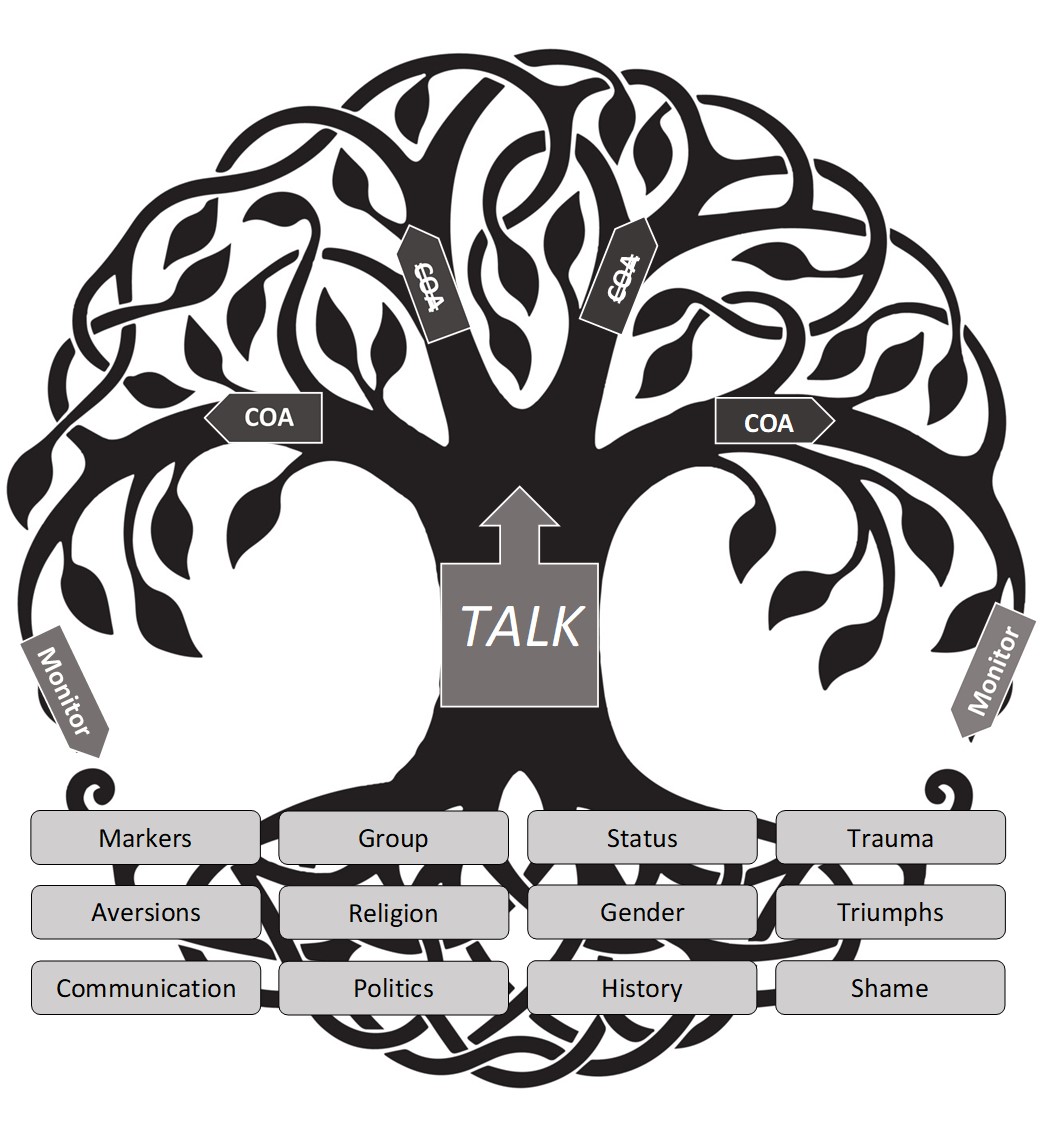
Markers – what we are
Your chosen audience will differentiate itself from others using markers, and you need to be aware of these markers in order for your message to connect with them.
There are key markers that we use to define our group identity, often making us different from others. These can stem from physical appearance, dress styles or other adornments. They can be traits of temperament, habit or communication style. They can also be rooted in geographical place: how our culture derives from our unique environment, and how we have traditionally carved out our niche within it.
The emic view of Ukrainians often emphasizes their strong sense of national identity, resilience, and connection to their land. Many Ukrainians pride themselves on their rich cultural heritage, folklore, music, and traditions. There’s often a strong emphasis on Ukrainian language, literature, and traditions as separate from Russian culture. By contrast, Russians view Ukrainians as “Little Russians” – a subset of Russian culture rather than a distinct nation. They have traditionally characterized Ukrainians as simple rural folk, embodied in the khokhol stereotype of the unsophisticated Cossack. Soviet movies often cast the competent star as Russian, whilst the foolish sidekick would be Ukrainian. Since 2014, Russian narratives have drawn on this to portray Ukrainians as misguided brothers led astray by the West. The Russian “brotherly nations” narrative promotes the idea of close cultural ties between Russians and Ukrainians, pushes a shared historical narrative that minimises Ukrainian distinctiveness and portrays Ukraine’s current pro-Western orientation as a betrayal of Slavic unity.
Ukrainians reject the historical Russian view of Ukraine as “Little Russia,” seeing it as denying their distinct national identity. Pro-Ukrainian campaigns often highlight Ukrainian cultural uniqueness to counter Russian narratives, showcasing Ukrainian innovations, art, and successes on the global stage and promoting the Ukrainian language in all spheres of life. Western campaigns follow this lead, using cultural events like Eurovision to celebrate Ukraine as the eventual winners in 2022 following Russia’s second invasion, broadcasting Ukrainian media footage from a bunker with eroded plaster and visible wiring to heighten the sense of Ukrainian plucky underdog heroism amid peril.
Symbolic objects are sometimes overt – I’m wearing my shirt to support Man City, so I’m one of you – and sometimes covert. Covert symbolism is sometimes known as a “dogwhistle” – a shout-out that can only be heard by the chosen few, not the mainstream. There is an intrinsically conspiratorial character to the dogwhistle: it sets up the Other as a threat that aims to bring the in-group down, while the in-group who can notice the dogwhistle is privy to special, privileged messaging, and therefore bound by its own conspiracy with the messenger. If messaging get dogwhistles right, it can target a very specific subsection of the audience, gather much respect since it knows the codes, and will also strengthen the identity of the minority group as well as the influencer’s bond with it.
Subtle linguistic markers have signified in-group status since the birth of history. These differences continue to be weaponised today. Language, along with other semiotic and social markers, defines group boundaries. The Shibboleth story in the biblical Book of Judges recounts how the Gileadites used a linguistic test to identify enemy Ephraimites trying to cross the Jordan River. The Gileadites asked suspected Ephraimites to say “Shibboleth.” Due to the different accent of their dialect, Ephraimites pronounced it as “Sibboleth,” revealing their identity. Those who failed the test were killed. The term “shibboleth” has since come to mean any custom or trait that distinguishes a particular group. We need to identify the shibboleths of groups we study, and consider how our enemies use our own as levers.